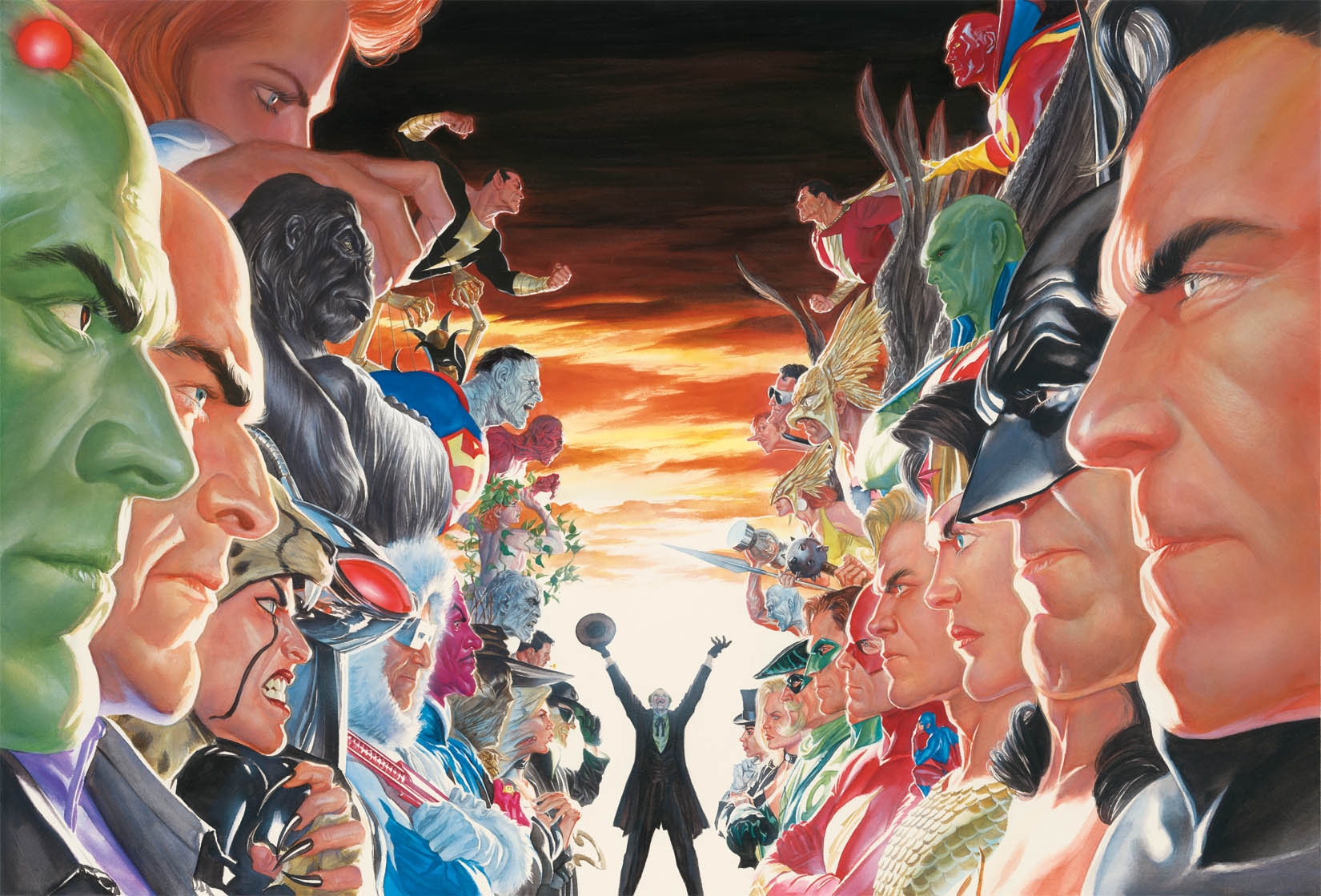
As one of the leading illustrators in the comic industry, Alex Ross’ influence cannot be understated. With a lifelong interest in comic books, Ross began creating at the age of 13. Roughly a decade later he was hired by Marvel Comics for the 1994 comic book event, Marvels (Alex Ross Art, n.d.). The son of a commercial artist, Ross followed in his mother´s footsteps and attended the American Academy of Art in Chicago, Illinois (Steinberg, 2018).
Known for his photorealistic, Norman Rockwell-esque work, Ross has become a gold standard for what comic book illustration can and should be. Creative passion and professionalism oozes from every publication his work is featured in. In an industry that finds itself engulfed in quantity, Ross´ level of craftsmanship is unparalleled. He’s won numerous Eisner and Harvey awards, the Ruben Award for his graphic novel, Fantastic Four: Full Circle, and consistently dominated the “Favorite Painter” and “Favorite Cover Artist” categories at the Comic Buyers Guide Awards until he was retired from nominee considerations.
His studio process begins with a plethora of reference images and pencil sketches. Ross’ references often come from still life photographs taken of himself or friends. He also utilizes poseable action figures when drawing from life, often having character models made for reference use. “You do research on your subject to execute the best possible illustration,” he notes (Alex Ross, 2024). After creating a general sketch of the figure or scene, he will then photocopy the image to be larger than the original image.
A lightbox is then used to trace the original image onto the final paper. Initially, Ross transferred his sketch ideas to the final paper by using his sight alone during the copying process, but noticed that much of the original charm was lost in translation. The lightbox allows him to make a near perfect copy of his own, original work, while magnifying it significantly larger than the original copy. While tracing, Ross uses a hard lead pencil—typically a 3H or 4H—to ensure that the lines are as minimal as possible before he begins the painting process. Ross states, “By looking at life, I’m checking what’s in my brain against what life will teach me along the way,¨ (Alex Ross, 2024). His references become invaluable during the tracing process, rebuilding his detail work to create his signature realism.
While he initially used oil paint in his work, he quickly transitioned to gouache. Gouache is a type of paint known for its opaque, matte finish and quick drying time. This medium is a water-based paint and can be revived once dried. Unlike oil paint, gouache dries incredibly fast, making it a preferable medium for illustrators. Where watercolor paints can be unpredictable and may pool in undesirable ways, gouache is able to be pulled and layered to the artist´s desired effect. Ross initially integrated gouache into his studio practice as he wanted a medium that dried quickly enough for illustration work, while also remaining ¨unremarkable¨ in its painterly qualities (Alex Ross, 2024).
Not all gouache paints are created with the same quality, and many artists have specific preferences with the brands they prefer. Ross notes that, “I happily use Holbein gouache paints, particularly, but also Winsor-Newton and other brands where necessary, “ (Willmetts, 2014). Both Holbein and Winsor & Newton brand gouache paints are known for their heavy body consistency and smooth opaqueness. These brands also utilize bright pigmentation to ensure colors will be fully saturated when used directly from their tubes. Like paint mediums, not all artist-grade paper is made the same. Ross typically uses Strathmore 4-ply, 500 Series Bristol board, which is a stiff, heavy paper that offers a smooth surface (Alex Ross, 2018). This hot press paper is ideal for water-based mediums and precise detail work. The lack of “tooth” also makes this paper an ideal choice for illustration work, as it can be easily scanned in and requires minimal photoshop retouching before going into mass production. Reportedly, Ross uses the Winsor & Newton Series 7 Kolinsky Sable brush in size four (McDaniel, n.d.). These brushes are notoriously expensive, as they are made from male Siberian weasel hair. The tail hair provides a crisp tip for detail work, while also having enough bristles for the body to be loaded with a large amount of paint. This combination of features equips artists with consistent brush control and even opacity when paint is applied.
Pulling from his training during art school, Ross begins his paintings with a grisaille layer similar to what is used in traditional oil paintings. Previously, Ross used a sepia, earth-toned grisaille when painting but disliked the muddiness of the final image. While the grisaille base is covered by the primary color pigments, the base hues will continue to shine through. By shifting to a grayscale and omitting the earth tones, Ross is able to create realistic values with minimal muddiness. When painting the color layer, Ross opts for a vibrant, primary color palette instead of tones that are overly mixed with neutrals and browns. Many of his highlights and shadows will be variations of blue and yellow, creating a stark contrast to the flesh tones.
For many artists, Ross’ painting methods are difficult to comprehend. From a technical standpoint, artists are trained to paint from the lightest values to the darkest when using water-based mediums, which starkly contradicts Ross’ grisaille layer to color technique. When painting, he will also incorporate watercolor into his work. Despite both being water-based, watercolor paint is significantly more transparent (and finicky) than its opaque, gouache counterpart. When combined, the mediums create the hyper realistic imagery that Ross is known for.
Alex Ross’ idiosyncratic style creates a pantheon of DC and Marvel heroes that are larger than life. While some will argue that his work is best suited for cover work rather than the more dynamic story pages, none can dispute the tremendous impact Ross has had not only on the comic book industry, but on the modern art world. His craftsmanship has placed his work among some of the greatest contemporary artists of the age. Ross isn’t likened to a current day Norman Rockwell without reason. His work is simultaneously timeless and current. Very few in the industry can compete with Ross’ skill and meticulous detail work, and in the age of AI and mass production, none may ever come close again.
“Alex Ross (Nelson Alexander Ross).” Illustration History, www.illustrationhistory.org/artists/alex-ross2. Accessed 31 Mar. 2026.
“Alex Ross Bio.” Alex Ross Art, www.alexrossart.com/pages/bio. Accessed 31 Mar. 2026.
“Alex Ross.” Animazing Gallery, www.animazing.com/alex-ross. Accessed 20 Mar. 2026.
McDaniel, Adam. “Look! Up on the Easel! .” AdamMcDaniel.Com, adammcdaniel.com/art_technique_superman.htm. Accessed 17 Mar. 2026.
Ross, Alex. “What Is Alex Ross’ Process? From Pencils to Finished Lineups.” YouTube, 2024, http://www.youtube.com/watch?v=dJX7VDIN2v0.
Steinberg, Neil. “The Capeless Crusader.” Chicago Magazine, www.chicagomag.com/chicago-magazine/october-2018/fall-arts-guide/alex-ross/#:~:text=Ross’s%20mother%20was%20a%20commercial%20illustrator%2C%20and,children%20in%20a%20house%20jammed%20with%20figurines. Accessed 20 Mar. 2026.
Willmetts, Geoff. “An Alex Ross Interview by Geoff Willmetts.” SFcrowsnest, 6 Nov. 2014, sfcrowsnest.info/an-alex-ross-interview-by-geoff-willmetts/.


 ComicBookClog